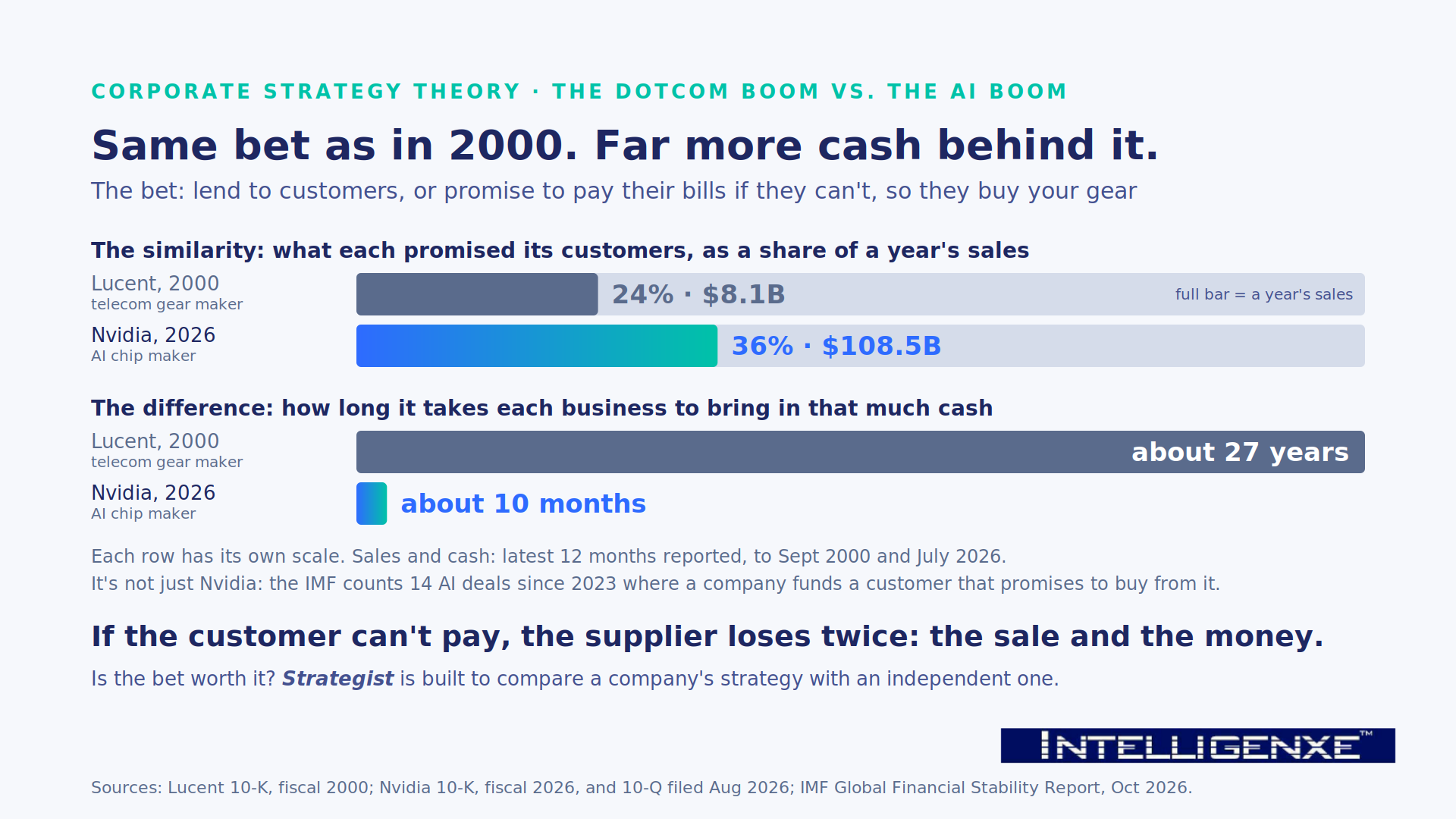
Chart: Lucent (2000) promised customers 24% of a year's sales, Nvidia (2026) 36%; cash to match: about 27 years vs 10 months.

Same tactic as 2000, very different cushion

posted in: AI Buildout, Blog | 0

The AI boom has revived a dotcom-era tactic: suppliers backing the customers who buy from them.

In September 2000, Lucent had promised $8.1B of loans and guarantees to the carriers buying its gear: 24% of a year’s sales. Nvidia has agreed to guarantee up to $108.5B of its customers’ data-center bills, 36% of a year’s sales, almost all for a campus leased to OpenAI that will run only Nvidia hardware.

The difference is the cushion. Lucent’s promises equaled about 27 years of the cash its business brought in. Nvidia’s equal about 10 months of its cash.

Backing customers is a strategy call, not a finance detail. Strategist is built to put an independent strategy beside management’s, for any public company.

Would you back your customers this way? strategist.intelligenxe.com
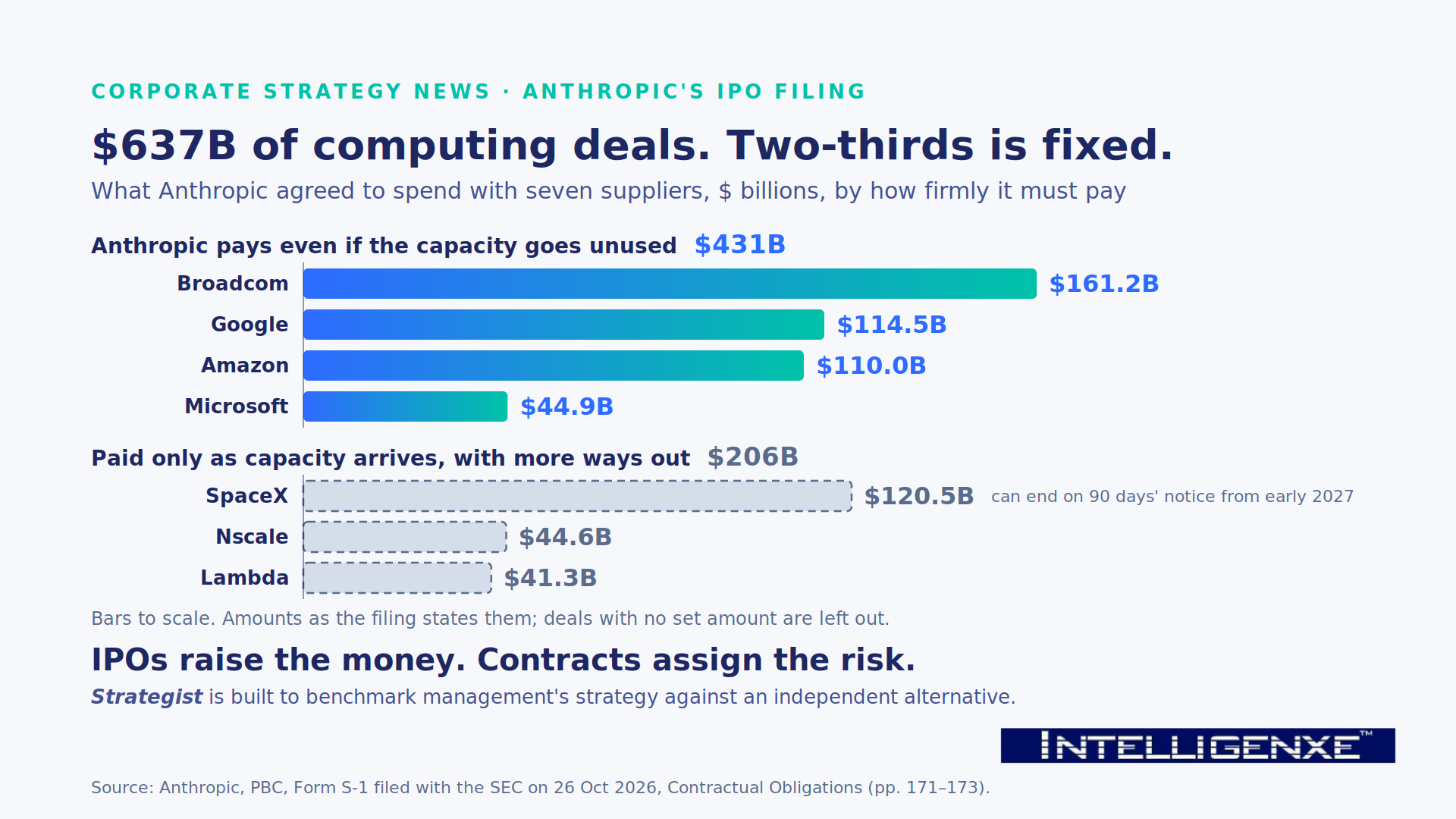
Bar chart of Anthropic's $637B computing deals: $431B owed even if unused, $206B paid only as capacity arrives.

The fine print behind the AI IPOs

posted in: AI Buildout, Blog | 0

Anthropic’s IPO filing details $637B of computing deals. The fine print matters more than the total.

Anthropic must pay Google, Amazon, Microsoft and Broadcom $431B whether or not it uses the capacity. SpaceX, Nscale and Lambda get $206B only as capacity arrives, with more ways out.

SpaceX raised $85.7B in its June IPO and spent $16.4B building out its AI unit last quarter, more than triple a year earlier. It has since agreed to lease about $40B of AI chips over five years. Either side can end its Anthropic deal on 90 days’ notice from early 2027.

IPOs raise the money; contracts assign the risk. Strategist is built to benchmark management’s strategy against an independent alternative.

Which side of the fine print are you on? strategist.intelligenxe.com

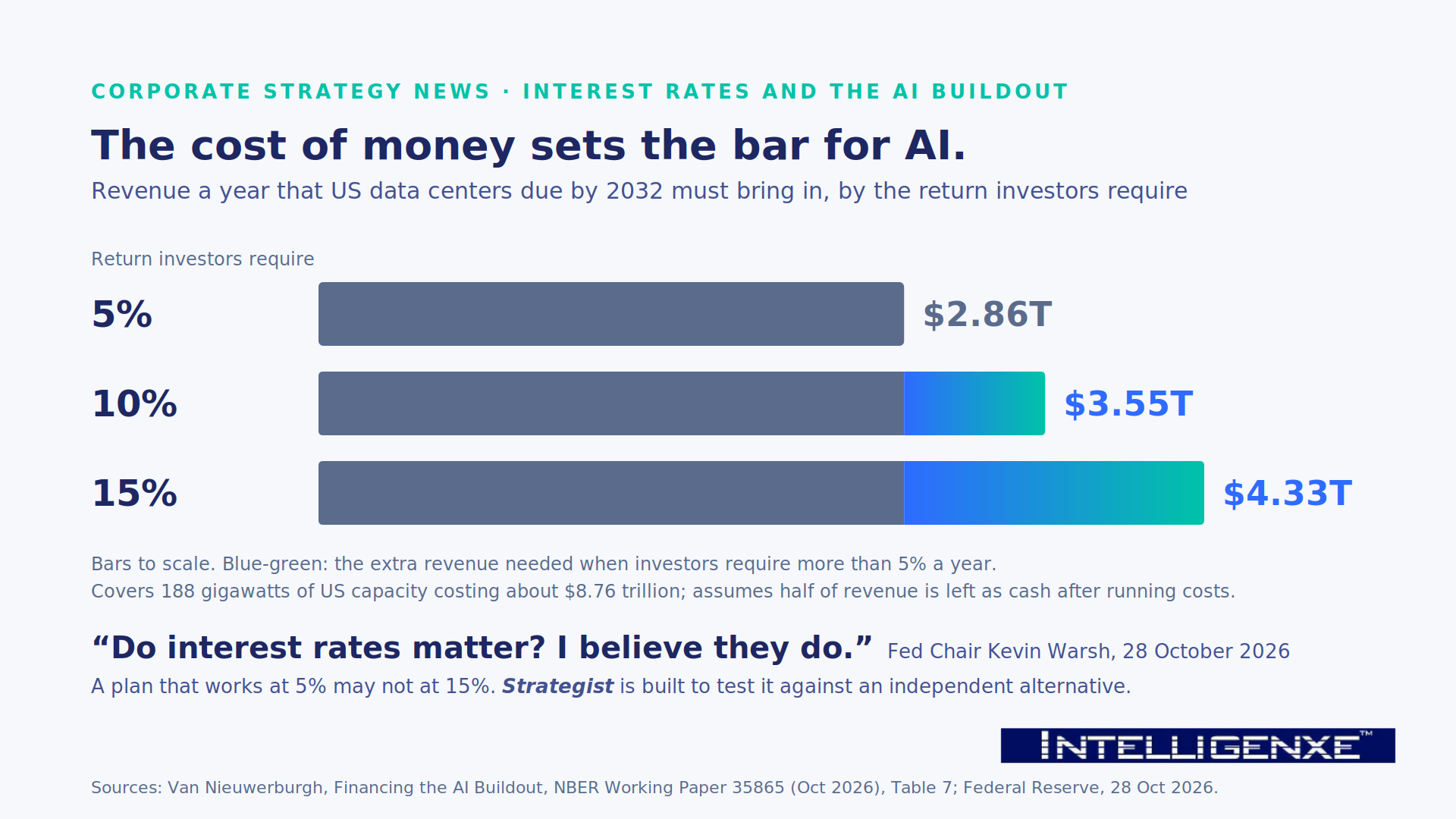
Bar chart, yearly revenue US data centers due by 2032 must earn: $2.86T at a 5% return, $3.55T at 10%, $4.33T at 15%.

The cost of money sets the bar for AI

posted in: AI Buildout, Blog | 0

Do interest rates matter to the AI boom? “I believe they do,” Fed Chair Kevin Warsh said on 28 October.

Since the Fed’s September hike, he said, investors have grown “somewhat more discerning.” In mid-October they wanted 15–16% a year to hold CoreWeave’s bonds. Meta, which burned cash last quarter, plans to sell up to $95B of stock.

The cost of money also sets the bar for the buildout. A Columbia/NBER study finds US data centers due by 2032 must bring in $2.86T a year if investors require a 5% return, $3.55T at 10% and $4.33T at 15%.

A plan that works at 5% may not at 15%. Strategist is built to benchmark management’s strategy against an independent alternative.

What cost of money is your AI plan built on? strategist.intelligenxe.com

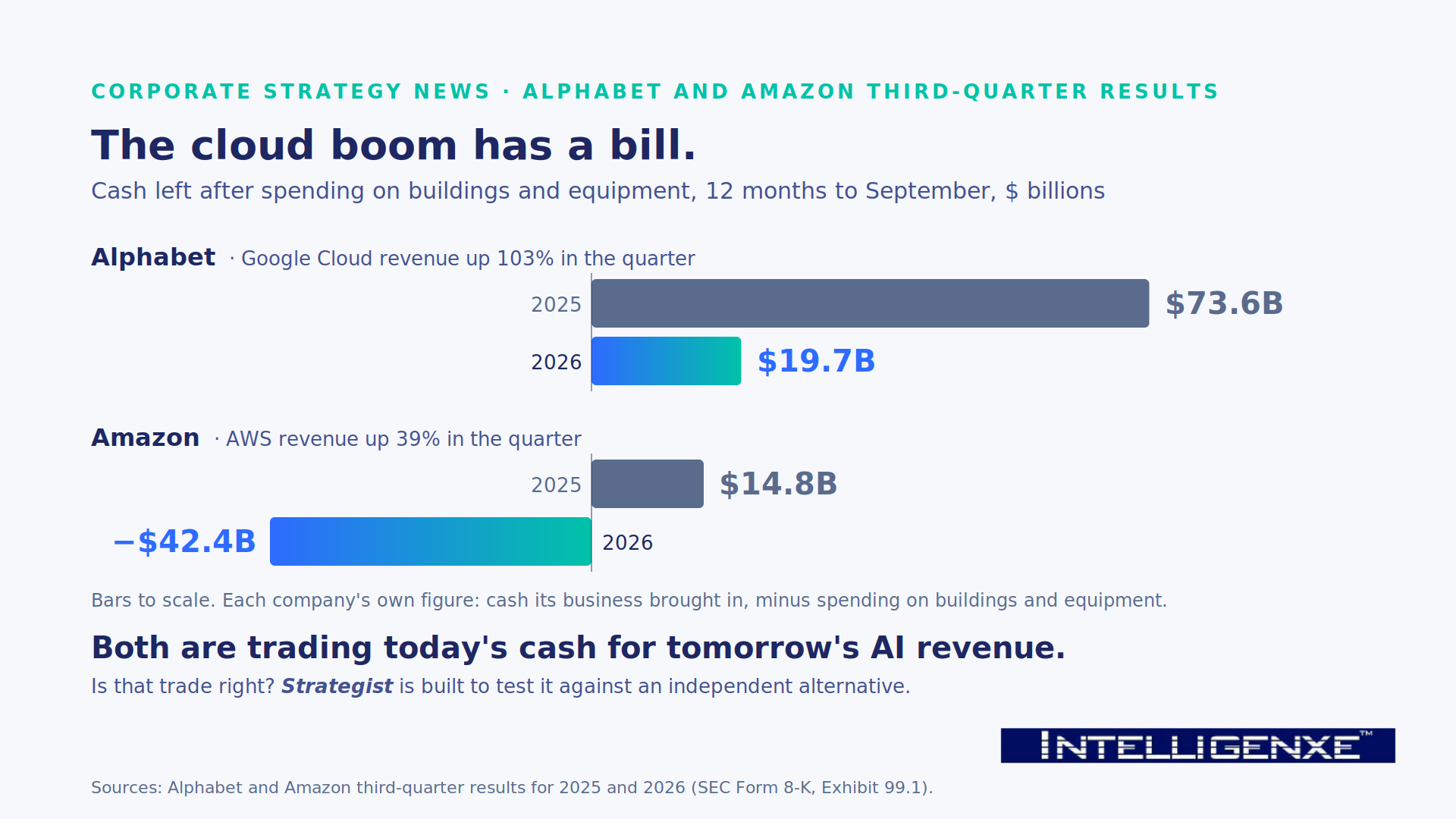
Bar chart, cash left after capital spending, 12 months to September: Alphabet $73.6B to $19.7B; Amazon $14.8B to −$42.4B.

The cloud boom has a bill

posted in: AI Buildout, Blog | 0

Google Cloud grew 103%. AWS grew 39%. Investors sold both.

Alphabet’s shares fell more than 12% on 29 October; Amazon’s dropped more than 6% after its results. The cloud boom has a bill: each more than doubled its quarterly spending on buildings and equipment. In the 12 months to September, the cash left after that spending fell to $19.7B at Alphabet, from $73.6B a year earlier, and to −$42.4B at Amazon, from $14.8B.

Both are trading today’s cash for tomorrow’s AI revenue. Whether that trade is right is a strategy question, best judged against an alternative.

Strategist is built to supply one: an independent strategy for any public company, with management’s benchmarked against it and every source shown.

Would you make the same trade? strategist.intelligenxe.com

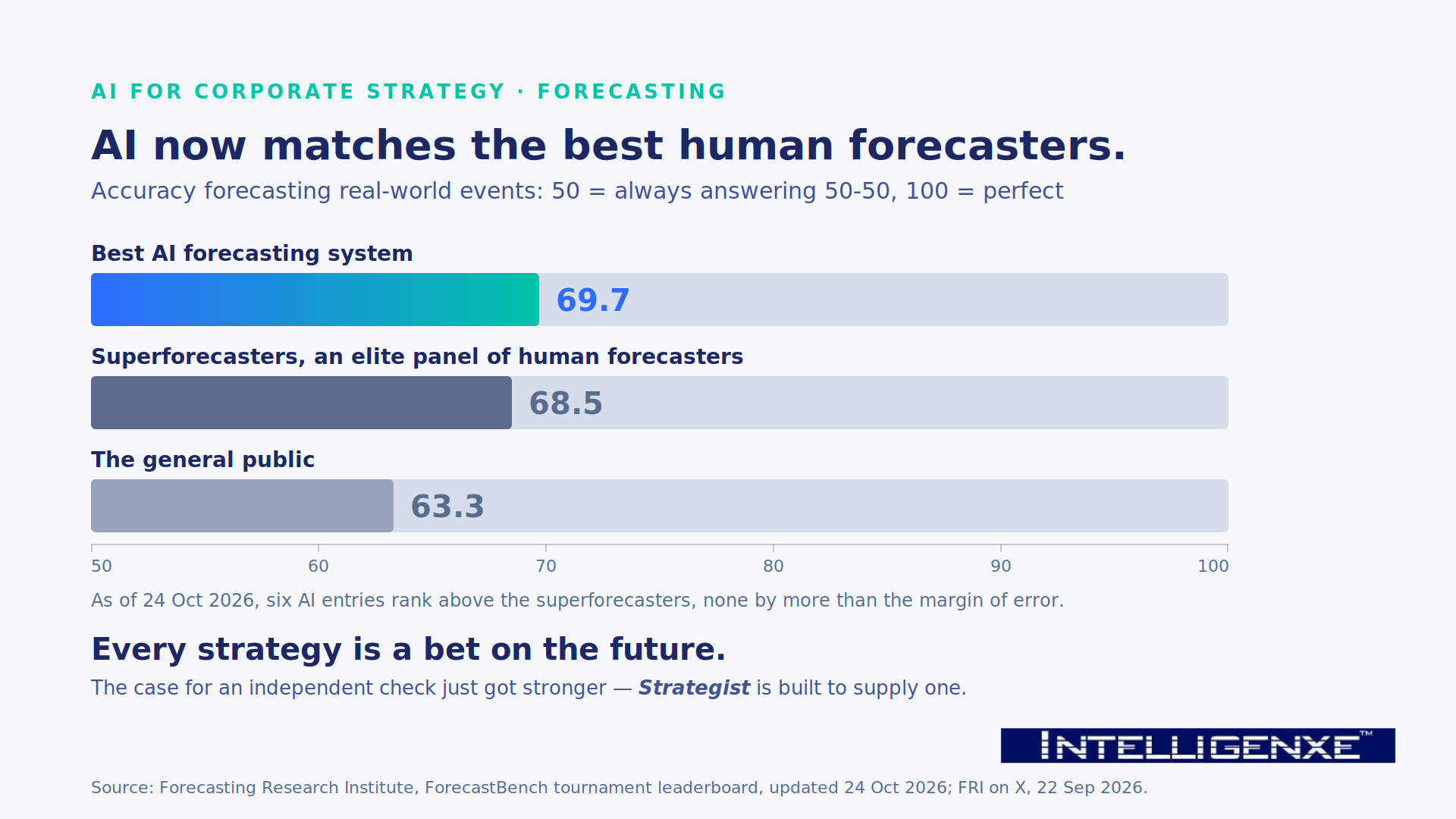
Bar chart of forecasting accuracy (50 = always 50-50, 100 = perfect): best AI 69.7, superforecasters 68.5, public 63.3.

AI now forecasts about as well as the best human forecasters

posted in: Blog | 0

AI now forecasts about as well as the best human forecasters.

ForecastBench, run by the Forecasting Research Institute, scores predictions about real-world events. As of 24 October, six AI entries rank above its superforecasters, an elite panel of human forecasters, though none by more than the margin of error. In March, the humans still led. A rematch with new forecasts from the superforecasters starts 25 October.

Every strategy is a bet on the future. The case for checking it against an independent view just got stronger.

Strategist is built to supply that view: an independent strategy for any public company, with management’s benchmarked against it and every source shown.

Which bet in your strategy has never faced an independent view? strategist.intelligenxe.com

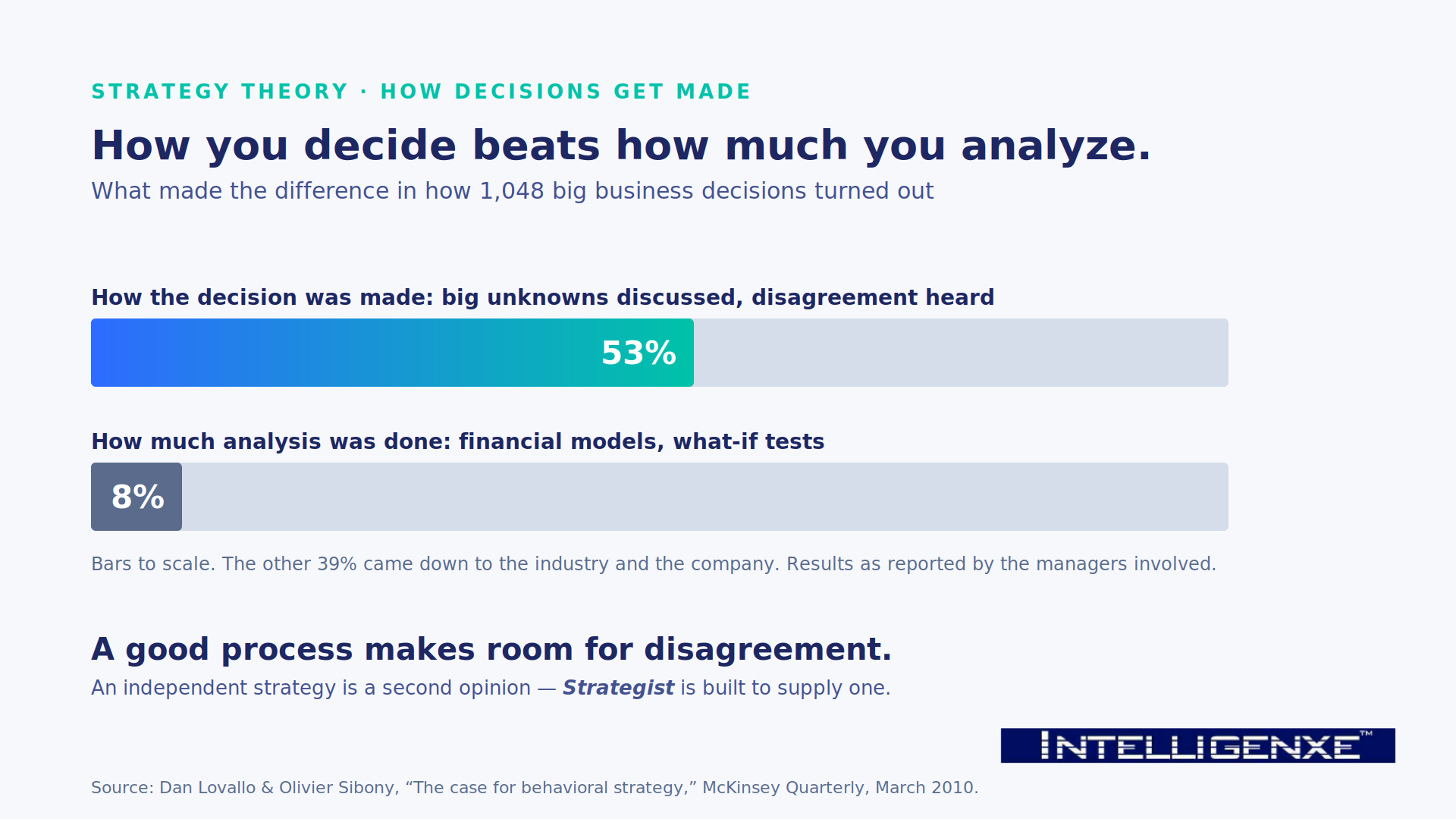
Bar chart, what drove the outcomes of 1,048 big business decisions: how the decision was made 53%, amount of analysis 8%.

How a decision gets made beats the analysis behind it

posted in: Blog | 0

How a big decision gets made matters more than the analysis behind it.

In a study of 1,048 major decisions, from acquisitions to large capital projects, Dan Lovallo and Olivier Sibony found that how a decision was made explained 53% of the difference in how it turned out. The amount of analysis behind it explained 8%. In the authors’ words, process mattered more than analysis “by a factor of six.”

Good process meant things like exploring the big uncertainties and hearing views that contradict the boss.

Strategist is built to supply that contrary view: an independent strategy for any public company, with management’s benchmarked against it and every source shown.

When did your last major decision face a real alternative? strategist.intelligenxe.com

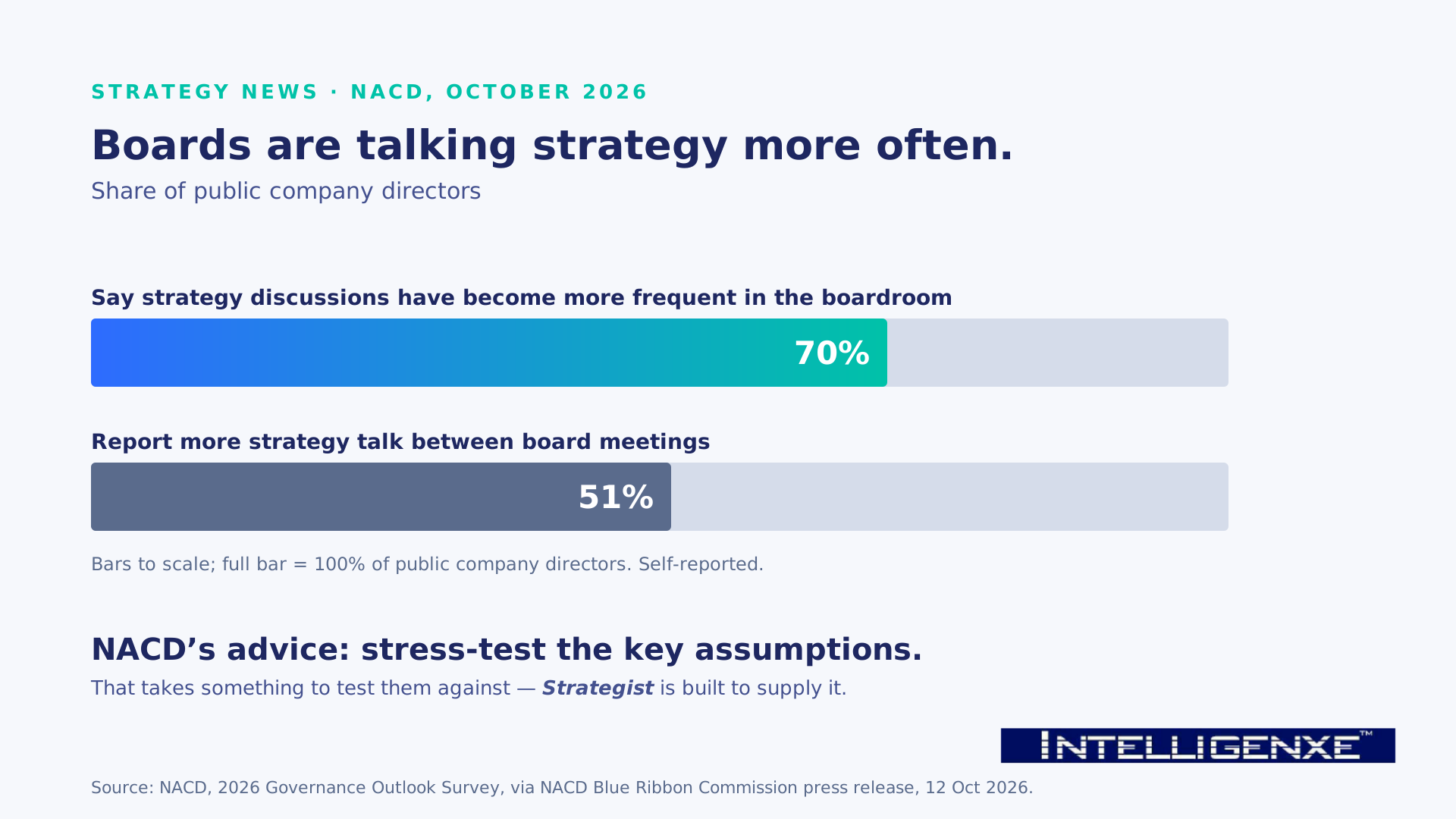
Bar chart, public company directors: 70% say boards discuss strategy more often; 51% report more of it between meetings.

Boards are talking strategy more often. Testing it is the hard part.

posted in: Blog | 0

70% of public company directors say strategy now comes up more often in the boardroom, and 51% report more strategy talk between meetings, per NACD’s 2026 Governance Outlook Survey. NACD’s new Blue Ribbon Commission report asks boards to agree on what success looks like, stress-test key assumptions and set signals that trigger a closer look.

Testing an assumption takes something to test it against.

Strategist is built for that: an independent strategy for any public company, with management’s benchmarked against it and every source shown.

Which assumption in your strategy hasn’t been tested lately? strategist.intelligenxe.com

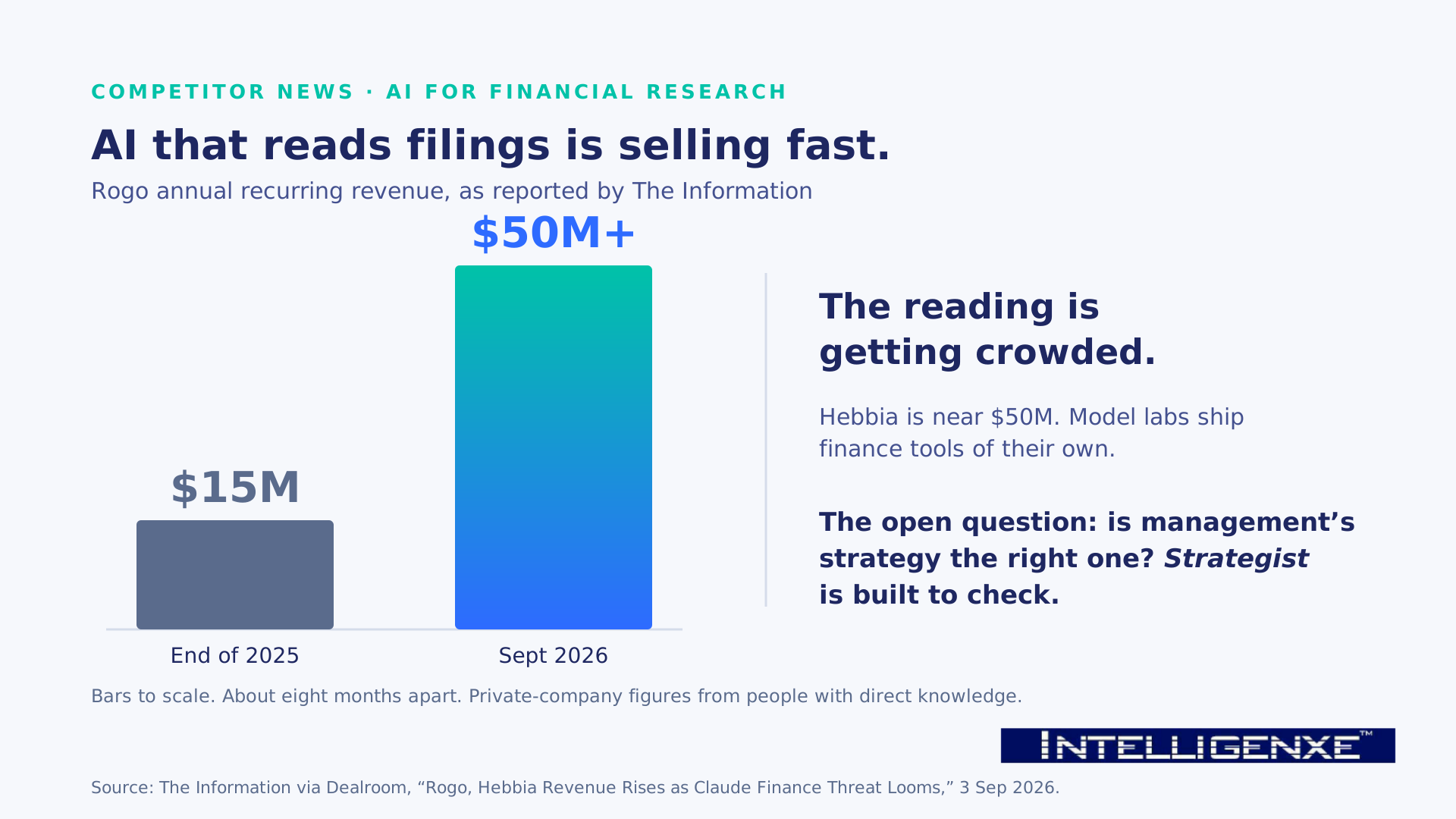
Bar chart: Rogo's annual recurring revenue rose from $15M at the end of 2025 to over $50M by September 2026.

AI that reads filings is selling fast. The edge is moving to judgment.

posted in: Blog | 0

Rogo’s annual recurring revenue more than tripled in about eight months: from $15M at the end of 2025 to over $50M by September, per The Information. Rival Hebbia is near $50M and recently won a Morgan Stanley rollout covering about 5,000 people.

Demand for AI that reads filings, transcripts and data rooms is real. So is the crowd chasing it: Anthropic and OpenAI now ship finance tools of their own, and some customers are building their own agents.

When everyone can read faster, the edge moves to judgment: is management’s strategy the right one?

Strategist is built for that question: an independent strategy for any public company, with management’s benchmarked against it and every source shown.

Who checks the strategy, not just the summary? strategist.intelligenxe.com

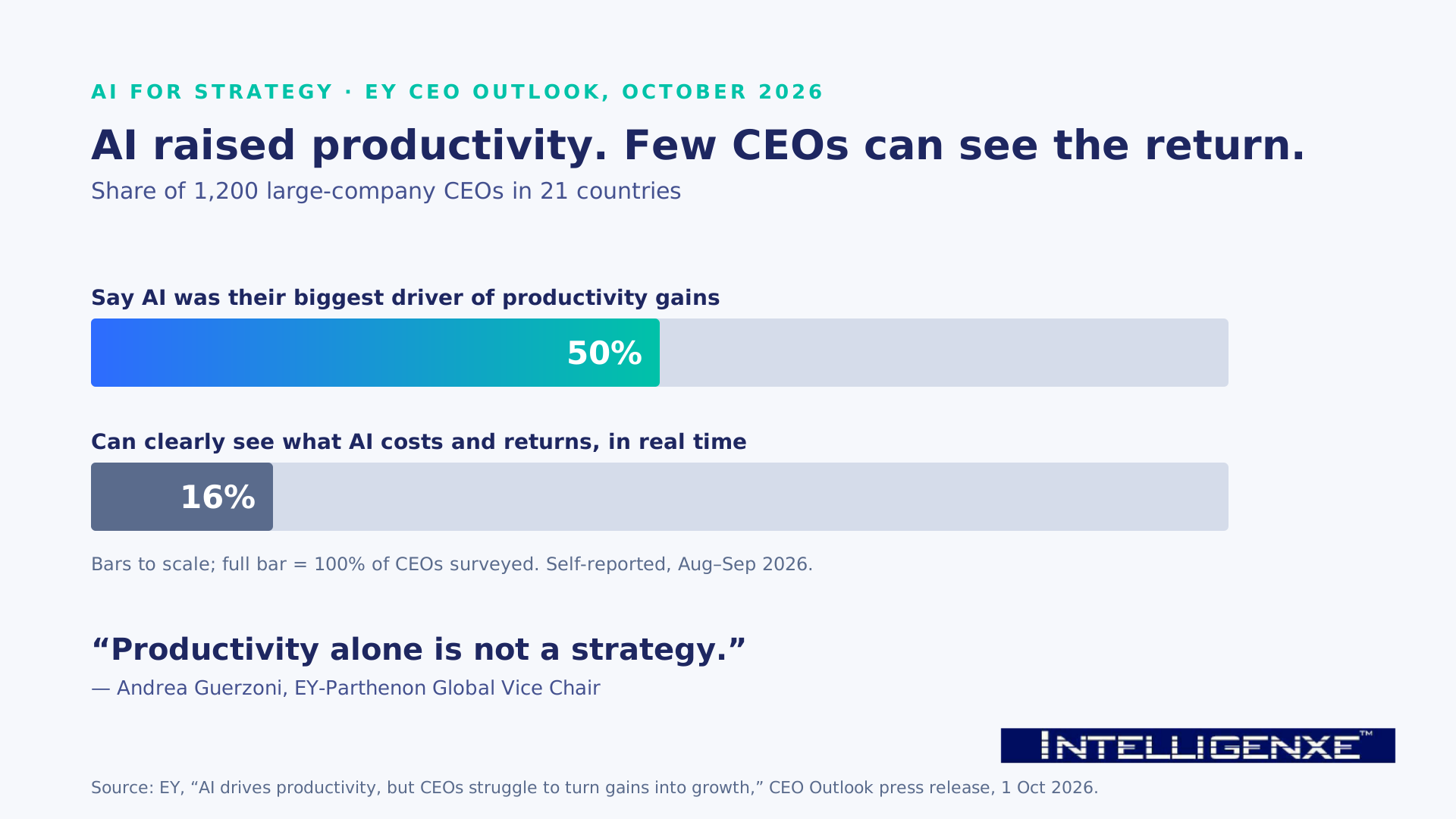
Bar chart, survey of 1,200 CEOs: 50% say AI drove their biggest productivity gains; 16% clearly see AI's costs and returns.

AI raised productivity. Only 16% of CEOs can see the return.

posted in: Blog | 0

Half of CEOs say AI drove their biggest productivity gains this year. Only 16% can clearly see what it returns.

That’s from EY’s October CEO Outlook, a survey of 1,200 large-company CEOs in 21 countries. Almost a quarter say AI gains are often absorbed before they reach the bottom line. EY-Parthenon’s Andrea Guerzoni put it plainly: “productivity alone is not a strategy.”

Faster work is an input. Whether it becomes profit depends on where the freed-up time and capital go next — and that is a strategy call.

Strategist is built to check that call: an independent strategy for any public company, with management’s benchmarked against it and every source shown.

Where is your AI productivity actually going? strategist.intelligenxe.com

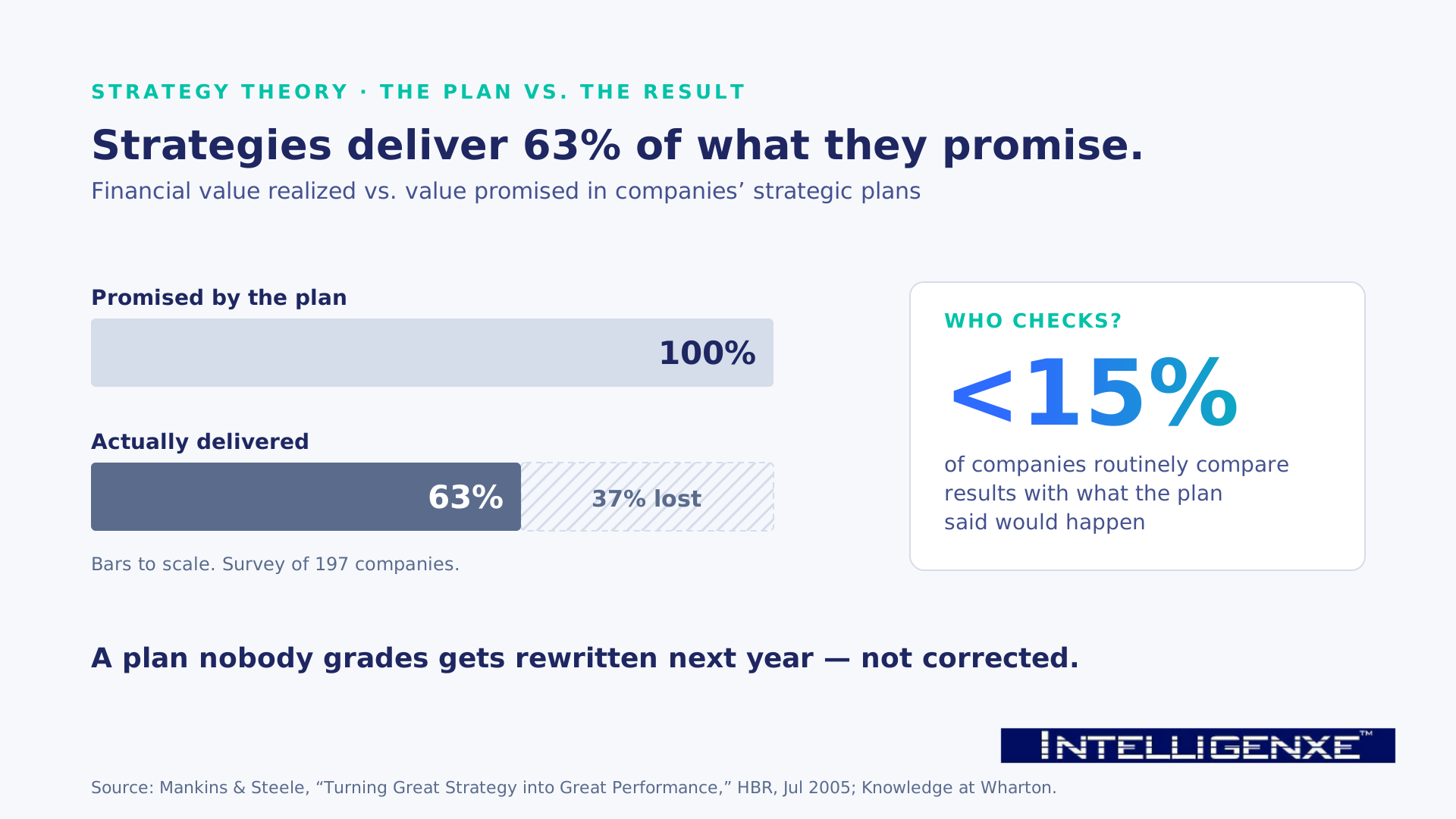
Bar chart: strategies deliver 63% of the value their plans promise; fewer than 15% of companies routinely check results.

Strategies deliver 63% of what they promise. Few companies check.

posted in: Blog | 0

Most strategies deliver about two-thirds of what they promise. Few companies routinely check.

In a survey of 197 companies, Michael Mankins and Richard Steele found firms realized only 63% of the financial value their strategic plans promised. Mankins’s sharper point: fewer than 15% of companies routinely compare how they performed with how they planned to perform.

A plan nobody grades gets rewritten next year, not corrected. The gap surfaces later — in missed targets, writedowns or an activist’s letter — long after the capital is committed.

Strategist is built to make that check routine: an independent strategy for any public company, with management’s benchmarked against it and every source shown.

Does your team grade last year’s plan before writing the next one? strategist.intelligenxe.com