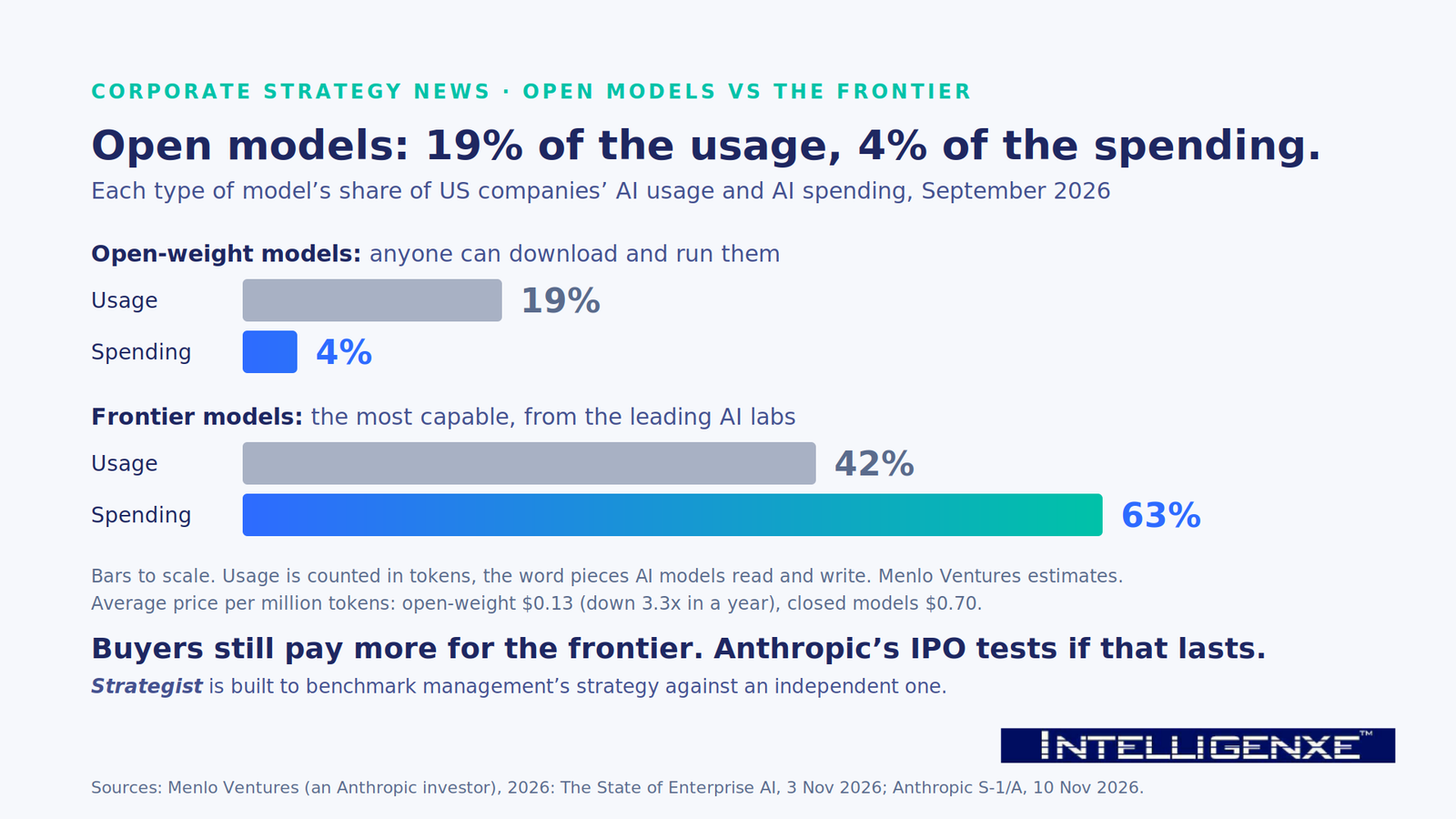
Open models: 19% of the usage, 4% of the spending.

Open models: 19% of the usage, 4% of the spending.

posted in: AI Buildout, Blog | 0

Open-weight AI models, which anyone can download, handle 19% of US companies’ AI usage, up from 11% a year ago. They get 4% of the spending.

Their average price fell 3.3x in a year, says Menlo Ventures, an Anthropic investor. The most capable “frontier” models handle 42% of usage but get 63% of spending. So far, models are commodities at the cheap end, not the top.

Anthropic could list next week at up to $1.4 trillion. Its filing warns customers may conclude frontier gains “do not justify the additional cost.” Last quarter, price cuts cost about $600 million, yet revenue rose to $17.0 billion. After the IPO, that test comes every quarter.

Strategist is built to benchmark management’s strategy against an independent one.

Lasting edge or head start? strategist.intelligenxe.com
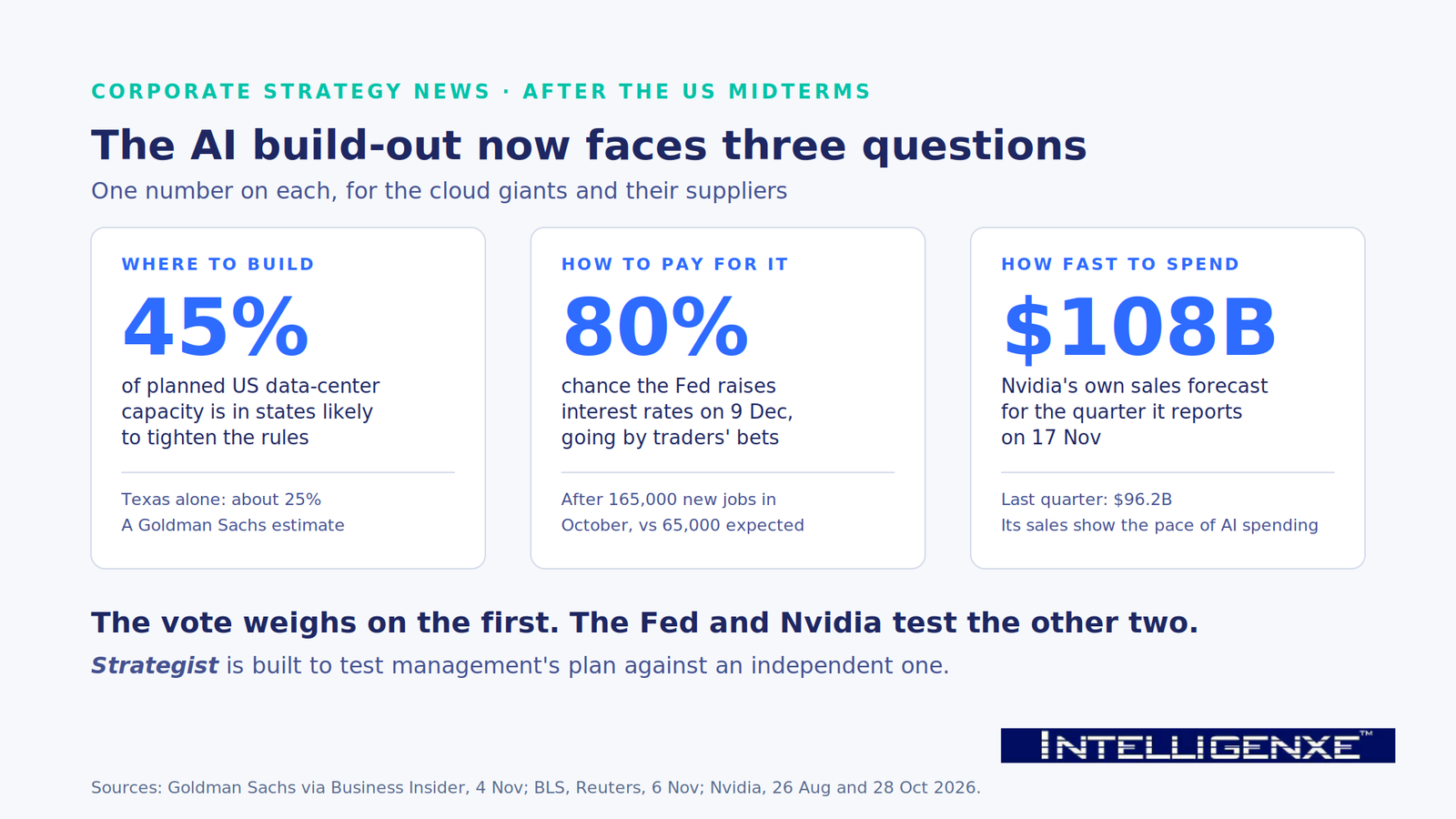
After the midterms, the AI build-out faces three questions: where to build, how to pay for it and how fast to spend.

After the midterms, the AI build-out faces three questions: where to build, how to pay for it and how fast to spend.

posted in: AI Buildout, Blog | 0

After the midterms, the AI build-out faces three questions: where to build, how to pay for it and how fast to spend.

The vote weighs on the first. Goldman Sachs estimates states likely to tighten data-center rules hold about 45% of planned US capacity, Texas alone about 25%. Voters backed limits in 40 of 41 local ballot measures.

The Fed and Nvidia test the other two. After 165,000 new jobs in October, against 65,000 expected, traders see about an 80% chance the Fed raises interest rates in December. Nvidia, whose sales show the pace of AI spending, reports on 17 November against its own $108 billion forecast.

Strategist is built to test management’s plan against an independent one.

Which question is your plan most exposed to? strategist.intelligenxe.com

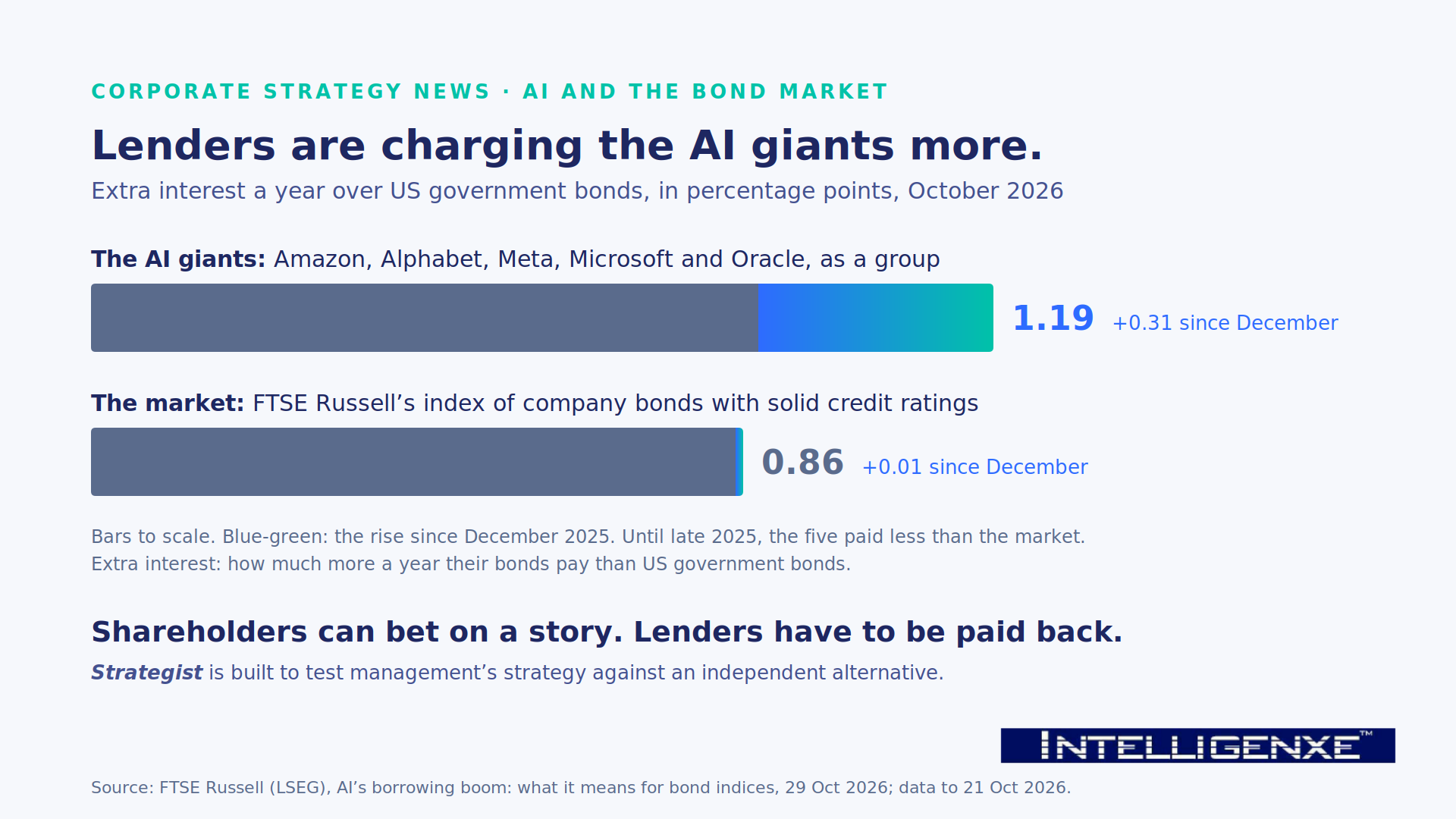
Bar chart: extra interest over US government bonds, Oct 2026: AI giants 1.19 points (up 0.31 since December), market 0.86.

Lenders are charging the AI giants more

posted in: AI Buildout, Blog | 0

Shareholders can bet on a story. Lenders have to be paid back.

The AI buildout now leans on lenders. US companies with solid credit ratings have sold a record $1.88 trillion of bonds this year, about a fifth by the tech giants building AI’s data centers.

Lenders are charging for it. Since December, the extra interest Amazon, Alphabet, Meta, Microsoft and Oracle pay over US government bonds is up about 0.31 percentage points, the market’s 0.01. As a group, they paid less than the market until late 2025; now they pay more.

A lender’s question is a strategy question: will the spending earn back its cost? Strategist is built to test management’s strategy against an independent alternative.

Would your AI plan pass that test? strategist.intelligenxe.com

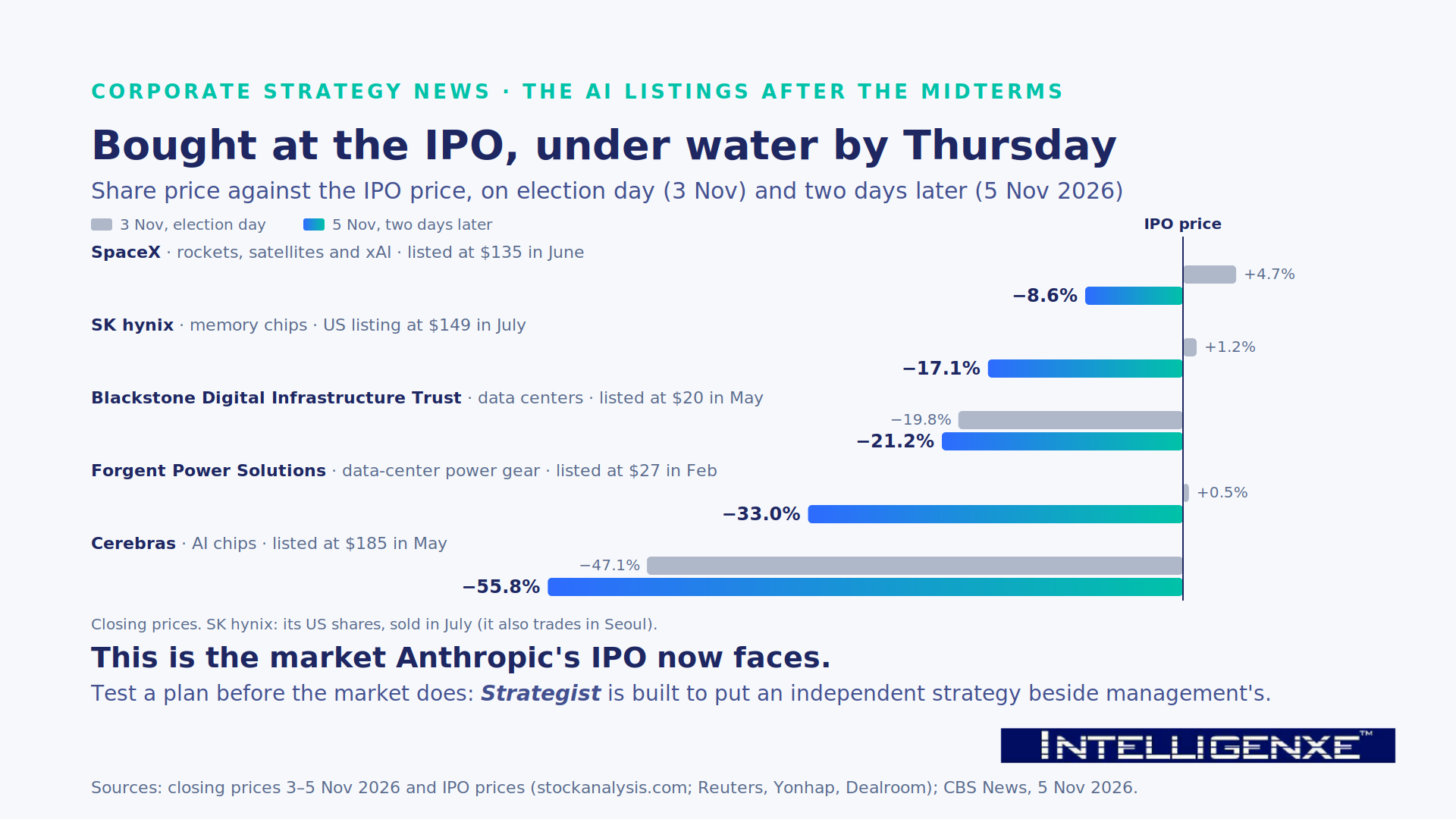
Bar chart, share price vs. IPO price on 5 Nov 2026: SpaceX −8.6%, SK hynix −17.1%, Forgent −33.0%, Cerebras −55.8%.

Two days after the midterms, SpaceX and SK hynix closed below their IPO prices.

posted in: AI Buildout, Blog | 0

Two days after the midterms, SpaceX and SK hynix closed below their IPO prices. On election day, both had closed above.

On Thursday the Nasdaq fell 5.5%; Cerebras ended 56% below its own. Capital Economics cites concern that Democrats “will seek to regulate the AI industry and restrict data center development.” Anthropic’s own IPO filing warns that data-center pauses “could delay or prevent” the facilities it relies on.

Anthropic was expected to list this month, raising up to $100 billion; Vital Knowledge says the rout could delay it. OpenAI cut its funding target from $30 billion to $20 billion.

Strategist is built to put an independent strategy beside management’s, so investors can test a plan before the market does.

Would your plan still work at Thursday’s prices? strategist.intelligenxe.com

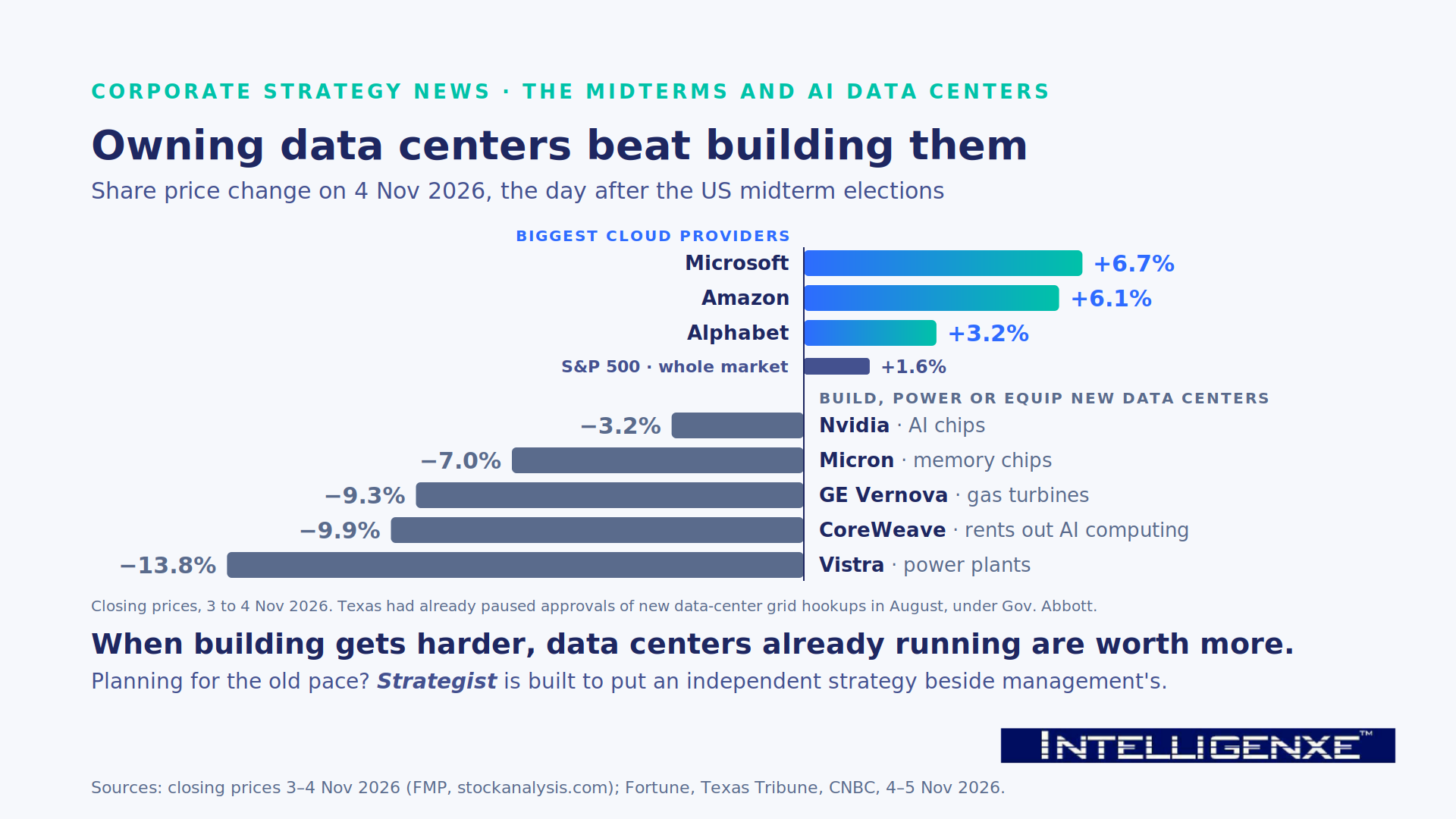
Bar chart, share moves on 4 Nov 2026: Microsoft +6.7%, Amazon +6.1%, Alphabet +3.2%; data-center builders fell 3.2% to 13.8%.

The day after the midterms, owning a data center beat building one.

posted in: AI Buildout, Blog | 0

Texas, Ohio and Georgia elected governors who campaigned on pausing or limiting new data centers. Microsoft’s shares rose 6.7% and Amazon’s 6.1%. Companies that build, power or equip new ones fell: power producer Vistra 13.8%, AI cloud CoreWeave 9.9%, turbine maker GE Vernova 9.3%, memory-chip maker Micron 7.0%.

JPMorgan’s James Sullivan says “existing capacity is significantly more valuable now.” Much of what is due in 2027 is already being built; Nomura says the bigger impact “may hit from 2028.” Permits and power, not just money, now set the pace.

Strategist is built to put an independent strategy beside management’s, so a plan that assumes the old pace stands out.

Which pace is your plan built for? strategist.intelligenxe.com

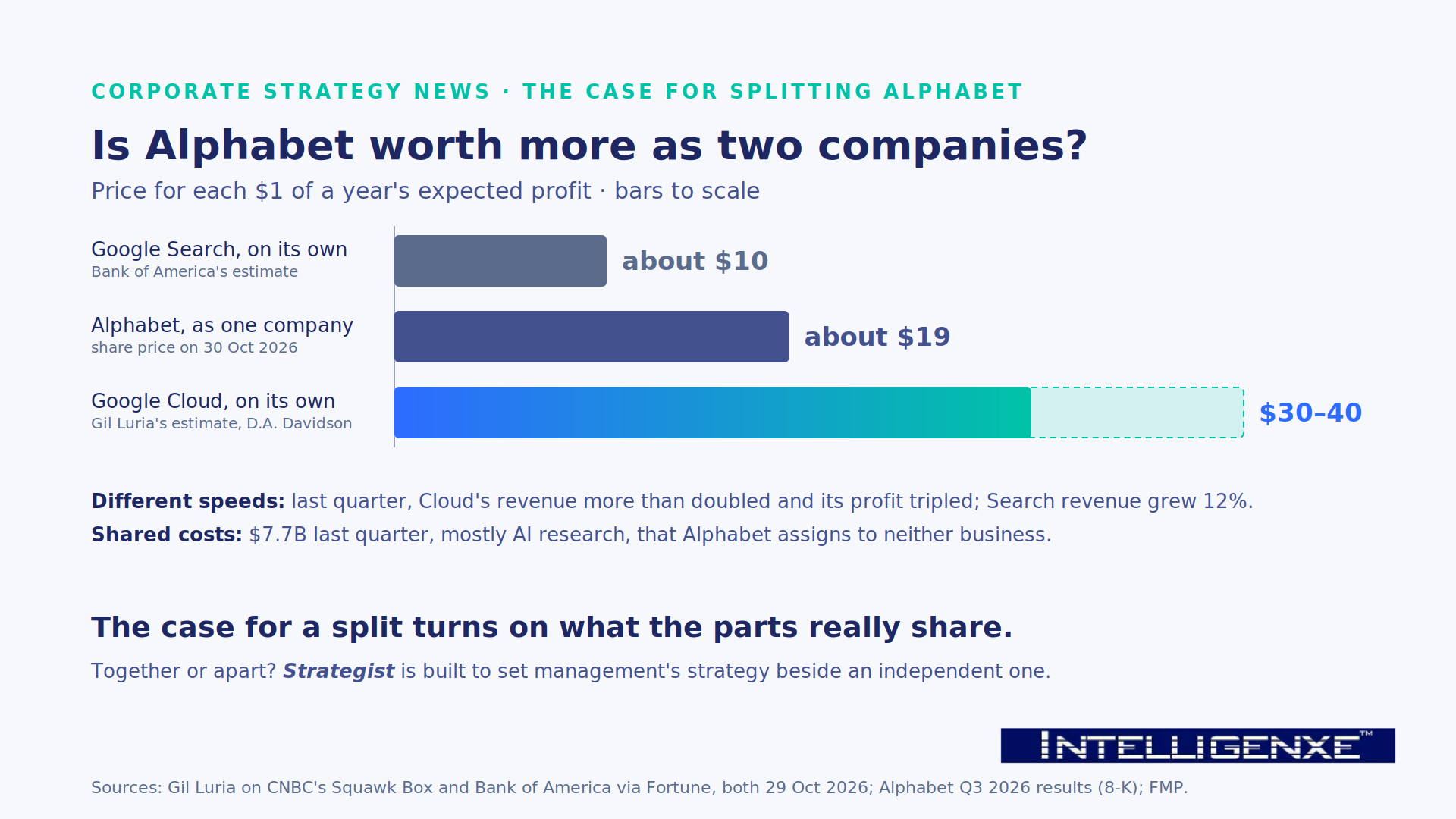
Bar chart, price per $1 of expected profit: Google Search alone about $10, Alphabet about $19, Google Cloud alone $30–40.

Is Alphabet worth more as two companies?

posted in: AI Buildout, Blog | 0

Its shares cost about 19 times next year’s expected profit. By Bank of America’s count, that price values Search at about 10 times. On CNBC, D.A. Davidson’s Gil Luria argued Google Cloud alone could fetch 30 to 40 times: its revenue more than doubled last quarter, while Search revenue growth slowed to 12% as more questions go to AI chatbots.

Luria sees little that Cloud and advertising share. Alphabet’s own accounts show one thing they do: $7.7B of costs last quarter, mostly shared AI research, charged to neither business.

Together or apart is a strategy call before it is a valuation. Strategist is built to put an independent strategy beside management’s, with every source shown.

Which would you choose? strategist.intelligenxe.com

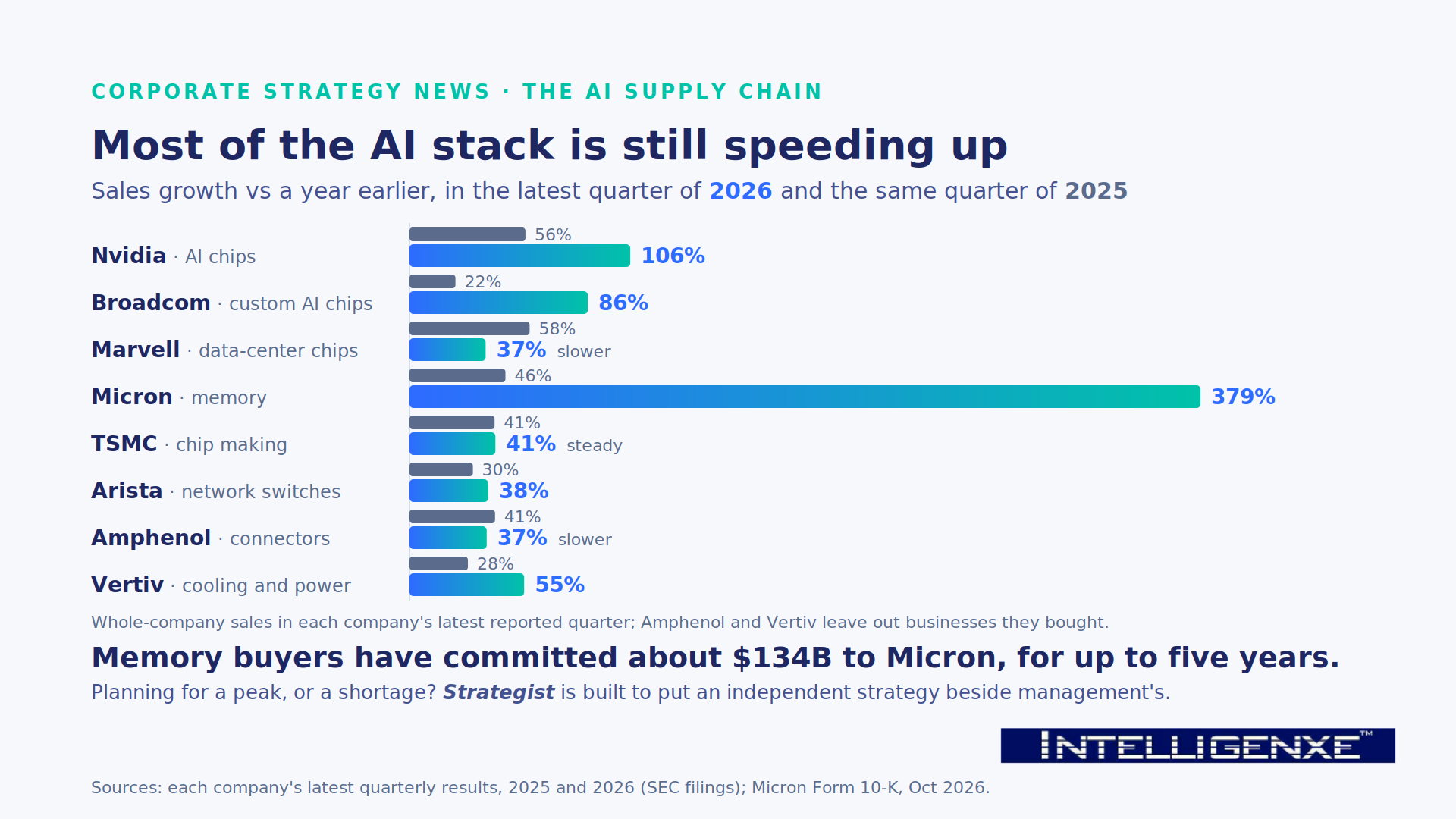
Bar chart, sales growth in the latest 2026 quarter: Micron 379%, Nvidia 106%, Broadcom 86%, Vertiv 55%, others 37–41%.

Most of the AI stack is still speeding up

posted in: AI Buildout, Blog | 0

Is AI spending peaking? Not in its suppliers’ latest numbers.

Of eight big AI suppliers, from chips to cooling, five are growing faster than a year ago: Nvidia, Broadcom, Micron, Arista and Vertiv. TSMC held steady at 41% growth; Marvell and Amphenol slowed. All eight expect higher sales next quarter.

Memory is short. A year ago, Micron had almost no long-term orders; now customers have committed to buy about $134B over up to five years, with $13B in deposits. Micron keeps 87 cents of each sales dollar after production costs, up from 45; Nvidia keeps 75.

Strategist is built to put an independent strategy beside management’s, so you can see if a plan is built for a peak or a shortage.

Which layer runs short next? strategist.intelligenxe.com

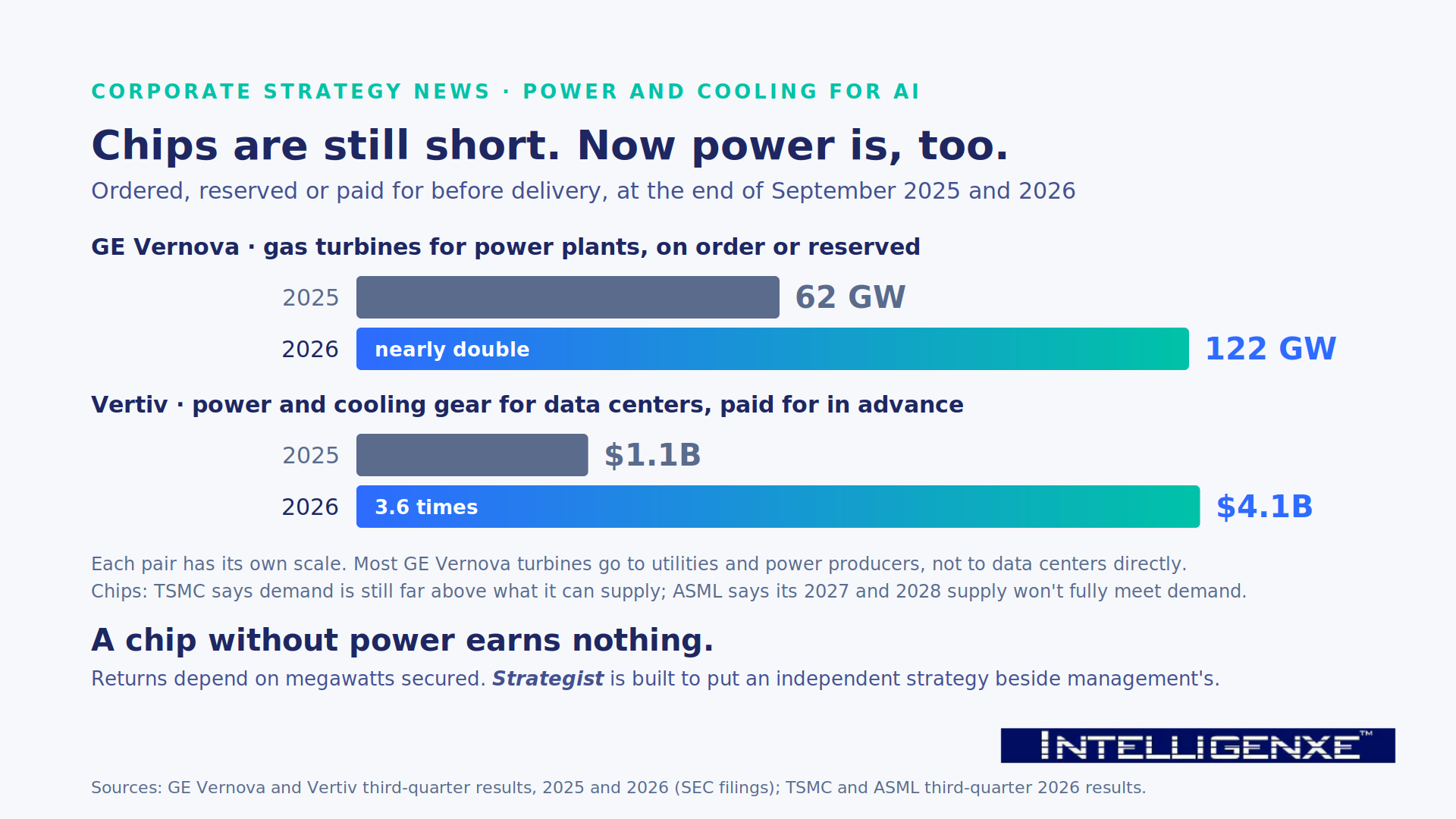
Bar chart, end of September 2025 vs 2026: GE Vernova turbine orders 62 GW to 122 GW; Vertiv advance payments $1.1B to $4.1B.

Chips are still short. Now power is, too.

posted in: AI Buildout, Blog | 0

ASML says its planned supply of chip-making machines won’t fully meet demand in 2027 or 2028. Gas turbines on order or reserved at GE Vernova nearly doubled in a year, to 122 gigawatts, and customers have paid power and cooling maker Vertiv $4.1B in advance, 3.6 times a year earlier.

The gear bill per megawatt is rising too: Vertiv now estimates it can sell $3.25–3.75M for each megawatt of data-center capacity, up 10–15% from its earlier range. A chip without power earns nothing, so returns depend on megawatts secured, not chips bought.

Strategist is built to put an independent strategy beside management’s, so a plan that counts chips but not megawatts stands out.

Which one limits your plan? strategist.intelligenxe.com

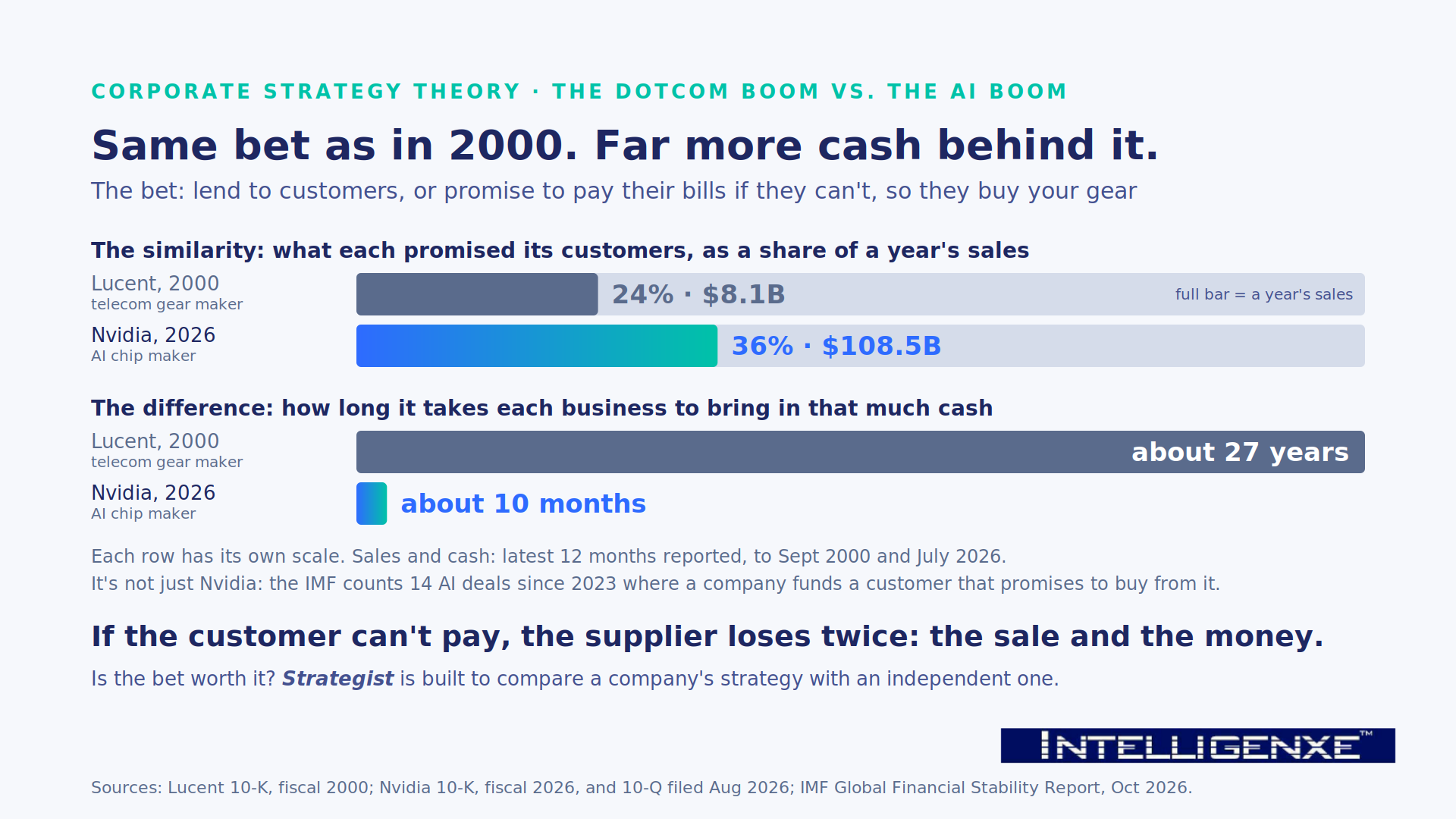
Chart: Lucent (2000) promised customers 24% of a year's sales, Nvidia (2026) 36%; cash to match: about 27 years vs 10 months.

Same tactic as 2000, very different cushion

posted in: AI Buildout, Blog | 0

The AI boom has revived a dotcom-era tactic: suppliers backing the customers who buy from them.

In September 2000, Lucent had promised $8.1B of loans and guarantees to the carriers buying its gear: 24% of a year’s sales. Nvidia has agreed to guarantee up to $108.5B of its customers’ data-center bills, 36% of a year’s sales, almost all for a campus leased to OpenAI that will run only Nvidia hardware.

The difference is the cushion. Lucent’s promises equaled about 27 years of the cash its business brought in. Nvidia’s equal about 10 months of its cash.

Backing customers is a strategy call, not a finance detail. Strategist is built to put an independent strategy beside management’s, for any public company.

Would you back your customers this way? strategist.intelligenxe.com

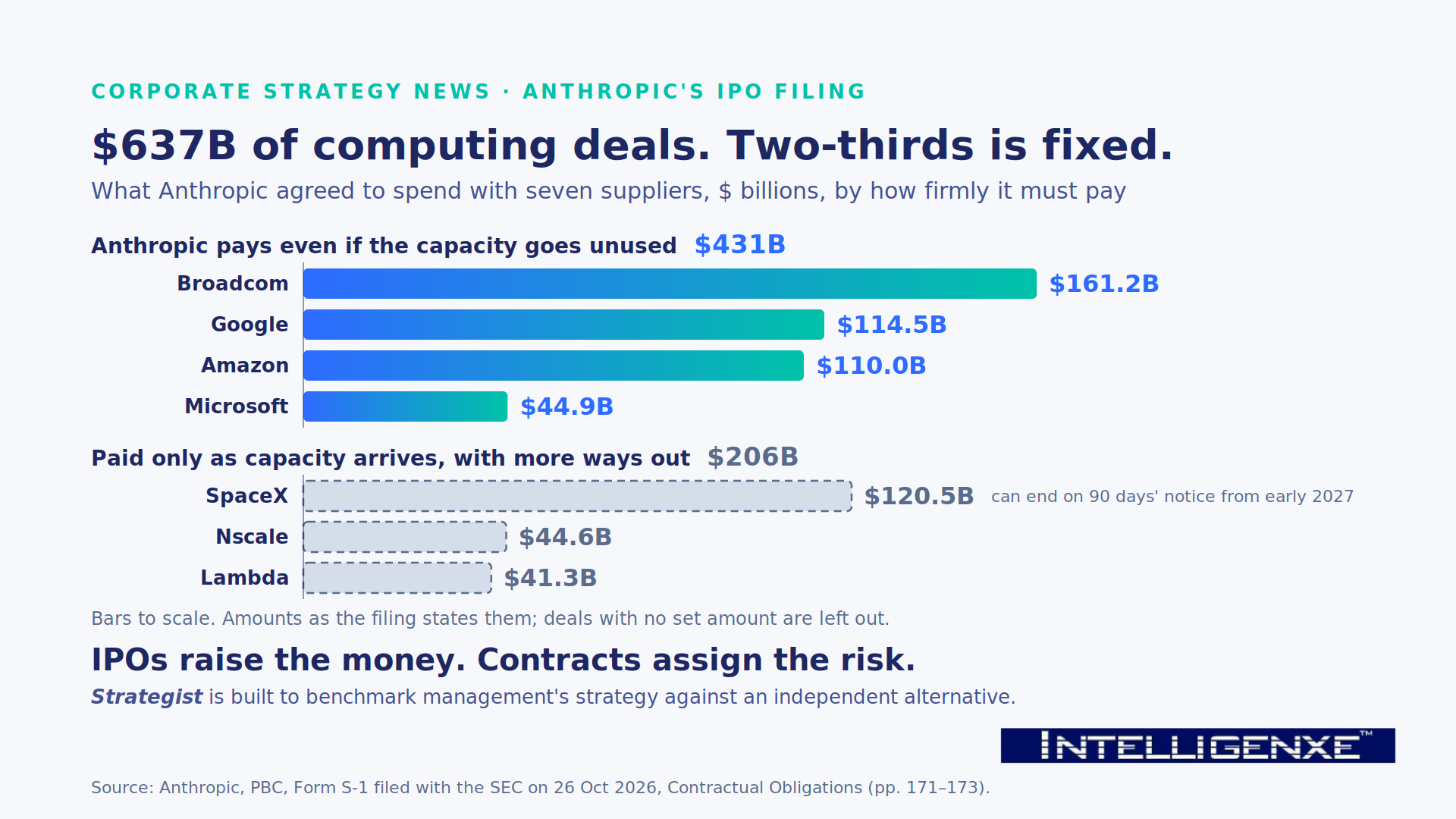
Bar chart of Anthropic's $637B computing deals: $431B owed even if unused, $206B paid only as capacity arrives.

The fine print behind the AI IPOs

posted in: AI Buildout, Blog | 0

Anthropic’s IPO filing details $637B of computing deals. The fine print matters more than the total.

Anthropic must pay Google, Amazon, Microsoft and Broadcom $431B whether or not it uses the capacity. SpaceX, Nscale and Lambda get $206B only as capacity arrives, with more ways out.

SpaceX raised $85.7B in its June IPO and spent $16.4B building out its AI unit last quarter, more than triple a year earlier. It has since agreed to lease about $40B of AI chips over five years. Either side can end its Anthropic deal on 90 days’ notice from early 2027.

IPOs raise the money; contracts assign the risk. Strategist is built to benchmark management’s strategy against an independent alternative.

Which side of the fine print are you on? strategist.intelligenxe.com